Claudio Giulianelli: Neo-Hermetic Visions Between Shadow, Symbol, and Renaissance Memory
Claudio Giulianelli (b. Rome, 1956) occupies a singular place in contemporary Italian figurative painting through his extraordinary ability to synthesize classical mastery with symbolic invention. Entirely self-directed in his artistic formation yet profoundly shaped by meticulous study of the Italian Baroque tradition, particularly Caravaggio, as well as the visionary worlds of Northern Renaissance and Flemish masters such as Hieronymus Bosch, Jan van Eyck, and Pieter Bruegel the Elder, Giulianelli has forged a visual language that transcends mere homage. His work is not an exercise in stylistic revival, but rather an act of transformation: historical technique becomes the foundation for a deeply personal mythology, one where allegory, femininity, and metaphysical tension converge. His biography consistently underscores this rare devotion to artisanal painting, emphasizing technical rigor, traditional oil preparation, and a disciplined commitment to craftsmanship that distinguishes him within today’s contemporary art landscape.
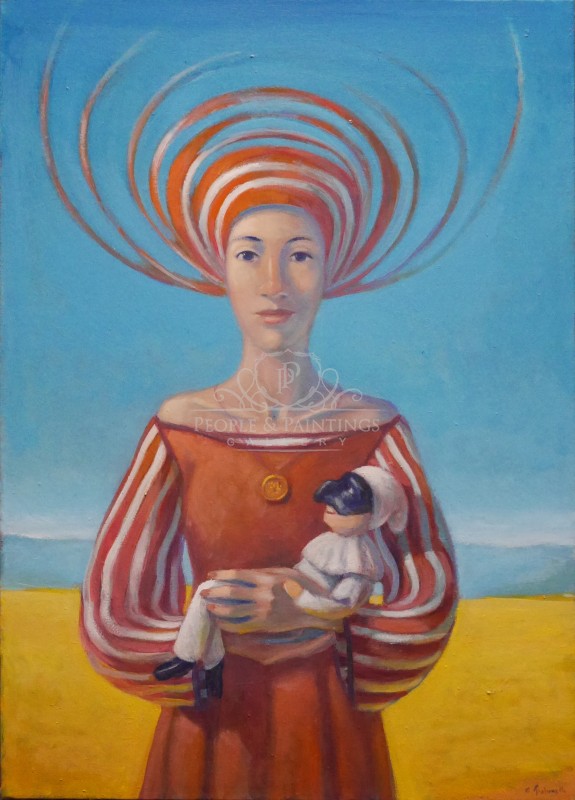
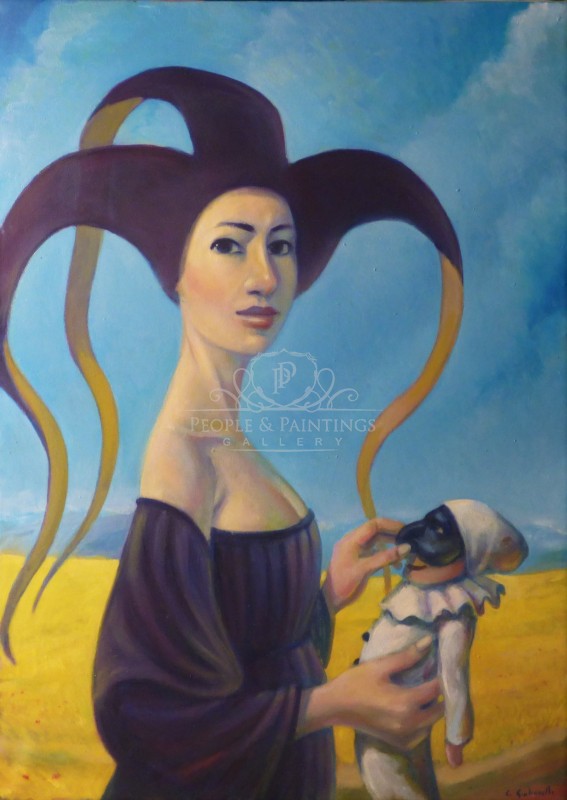
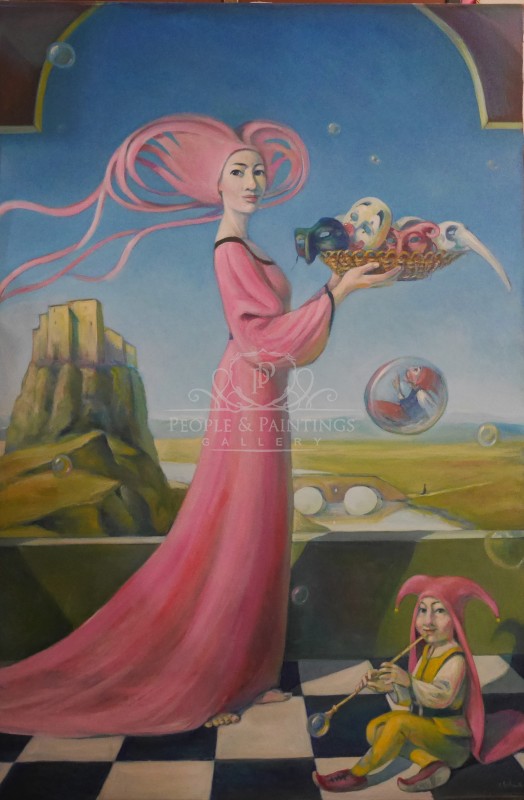
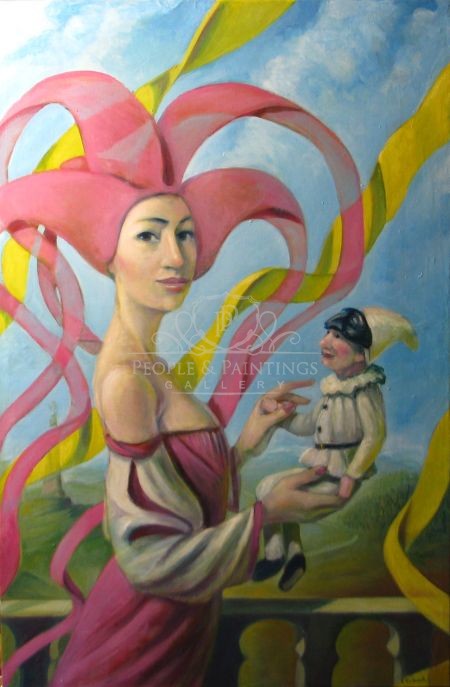
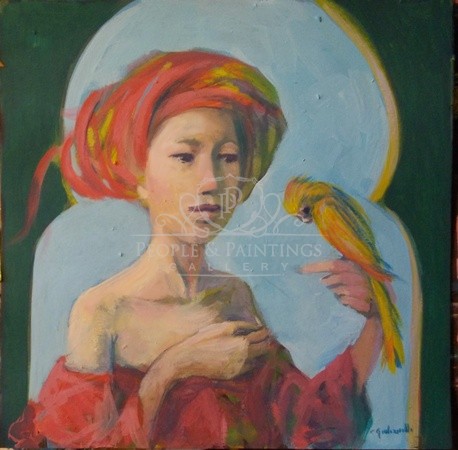
What defines Giulianelli most powerfully is the coherence of his symbolic universe. Across his body of work, one encounters recurring archetypes: enigmatic women, noble figures, queens, muses, and spiritual presences whose poised stillness evokes both authority and mystery. These figures are rarely simple portraits; they function instead as psychological emblems, suspended between sacred icon and theatrical apparition. Giulianelli repeatedly situates them in carefully orchestrated settings: ornate interiors, liminal thresholds, or dreamlike landscapes saturated with golden light – creating a world that feels at once medieval, Renaissance, and entirely imagined. This repetition is not decorative redundancy; it is the construction of a self-contained cosmology.
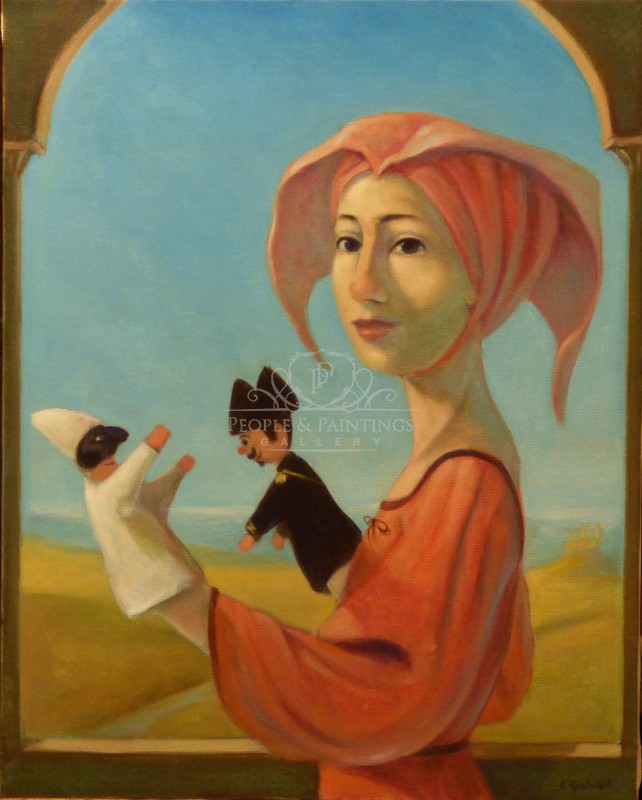
Among his most striking recurring motifs are marionettes, puppets, masks, and symbolic objects that complicate the apparent serenity of his compositions. These elements introduce layers of philosophical inquiry into his paintings, suggesting meditations on control, illusion, identity, and the performative nature of existence. Like Bosch, Giulianelli uses symbolic excess not merely for fantasy, but to stage moral and psychological theater. Yet unlike Bosch’s often chaotic compositions, Giulianelli’s paintings retain a formal elegance and portrait-like stillness rooted in Italian classicism. The result is a rare duality: his works are visually seductive, yet conceptually unsettling.
Chromatically, Giulianelli’s palette is among his most recognizable artistic signatures. He consistently returns to a sophisticated range of ochres, sepias, antique golds, earthy umbers, velvety blacks, muted greens, and deep crimson accents. These tones imbue his canvases with an atmosphere of aged opulence, evoking the patina of Renaissance panel painting or the burnished glow of Baroque interiors. Gold, in particular, functions not simply as color but as symbolic space – an illumination that often appears behind or around his subjects, suggesting transcendence, memory, or revelation. This chromatic consistency creates visual continuity across his oeuvre, reinforcing the sense that each painting belongs to an interconnected metaphysical world.
The female figure remains central to Giulianelli’s practice, but not in any conventional portrait tradition. His women are sovereign, enigmatic, and psychologically charged. They often occupy threshold spaces – windows, doorways, openings – where the external landscape becomes a symbolic extension of inner consciousness. Through these repeated compositional strategies, Giulianelli constructs a persistent dialogue between interiority and exteriority, between the seen and the concealed. His women are not merely subjects; they are guardians of his symbolic architecture.
Technically, Giulianelli’s devotion to oil painting and layered construction is inseparable from his identity. His surfaces reveal the patience of glazing, the structural intelligence of classical composition, and the hand of an artist deeply committed to preserving the tactile dignity of painting. Yet this technical historicism never feels academic. Instead, Giulianelli uses it to invent what might be called an “imagined antiquity”: a world shaped by Renaissance precision, medieval allegory, and contemporary psychological symbolism. In this way, he creates not historical paintings, but timeless ones.
His exhibition history and curatorial activity further reinforce his importance. Through international exhibitions spanning Europe, New York, China, and Abu Dhabi, as well as his leadership through Mega Art Gallery, Giulianelli has positioned himself not only as an artist but also as a cultural force. His accolades and institutional presence demonstrate that his work resonates across borders precisely because it merges universally recognizable beauty with esoteric complexity.
Ultimately, Claudio Giulianelli’s style may best be understood as neo-hermetic figurative symbolism – a contemporary resurrection of Renaissance and Flemish intelligence filtered through an intensely personal symbolic lens. His recurring visual vocabulary – regal femininity, marionettes, masks, golden distances, and psychological staging – forms a cohesive artistic signature that is unmistakably his own. In a contemporary art world often dominated by fragmentation, Giulianelli offers something increasingly rare: a unified mythos. His paintings do not simply depict; they invoke. They summon viewers into spaces where darkness and illumination coexist, where beauty is inseparable from enigma, and where the language of historical painting becomes newly alive.
This week (May 4-10), Giulianelli’s work is being specially highlighted by People & Paintings Gallery in anticipation of next week’s Juried Exhibition, From Darkness to Light, through the Curator’s Art Presentation series. This timely presentation is especially fitting, as Giulianelli’s visual language has long revolved around the dynamic interplay between obscurity and revelation. His paintings embody the very threshold suggested by the exhibition’s title: from shadow into illumination, from mystery into insight. Through his haunting female presences, luminous gold atmospheres, and symbolic theatricality, Giulianelli transforms darkness into a space of introspection and light into a condition of spiritual emergence. As such, his inclusion in From Darkness to Light is not merely appropriate—it feels conceptually inevitable. His work stands as a profound testament to the enduring power of painting to navigate the unseen, revealing how, through art, darkness itself may become the essential passage toward transcendence.
Cosmina Marcela OLTEAN
- More works and info about the artist: [https://peopleandpaintings.com/claudio_giulianelli]
- The exhibition: [https://peopleandpaintings.com/exhibitions/from_darkness_to_light]
- Sources:
- People & Paintings artist profile and biography page (primary source): https://peopleandpaintings.com/claudio_giulianelli
- Art in World artist biography: https://www.artinworld.com/Artista.aspx?ID=0000EF
- Gigarte biographical profile: https://www.gigarte.com/claudiogiulianelli/biografia
- Exibart event and exhibition references: https://www.exibart.com/evento-arte/mega-art-friends/
- VerbumPress profile and critical overview: https://www.verbumpress.it/claudio-giulianelli-artista-ermetico/