White Stork Migration, Metal Detecting, and Archaeology – A Story of Unexpected Discoveries
In recent years, a hobby has seen significant growth in Romania: metal detecting. While in the early 2000s there were only a few thousand licensed detectorists, by 2025 their number had exceeded 60,000. This evolution has been supported both by advances in detection technology and by the clarification of the legal framework governing the purchase, authorization, and practice of this activity in compliance with current regulations.
It is not uncommon for the media to report important discoveries made by “amateur archaeologists” or “history enthusiasts” who, in accordance with the law, hand over their finds to local authorities. These objects are subsequently evaluated and examined, and discoverers may be rewarded by the Romanian state.
One key advantage of licensed detectorists is that they operate legally, avoiding archaeological sites listed in the National Archaeological Record (RAN) and protected areas included in the List of Historical Monuments (LMI 2020). Beyond the legal aspect, most detectorists are passionate about history, nature, and hiking, contributing to the promotion of national heritage while sometimes benefiting from rewards for their efforts.
However, metal detecting is not an easy activity. From planning routes to working in the field, unexpected situations may arise: encounters with wild animals or interactions with landowners reluctant to allow ground intervention. Despite these challenges, detecting remains, at its core, a form of searching—from lost objects to possible treasures—as well as an engaging and active way to spend time in nature.
Moreover, detectorists can become a valuable resource for archaeological research and beyond, contributing indirectly to studies related to nature, biodiversity, and other connected fields.
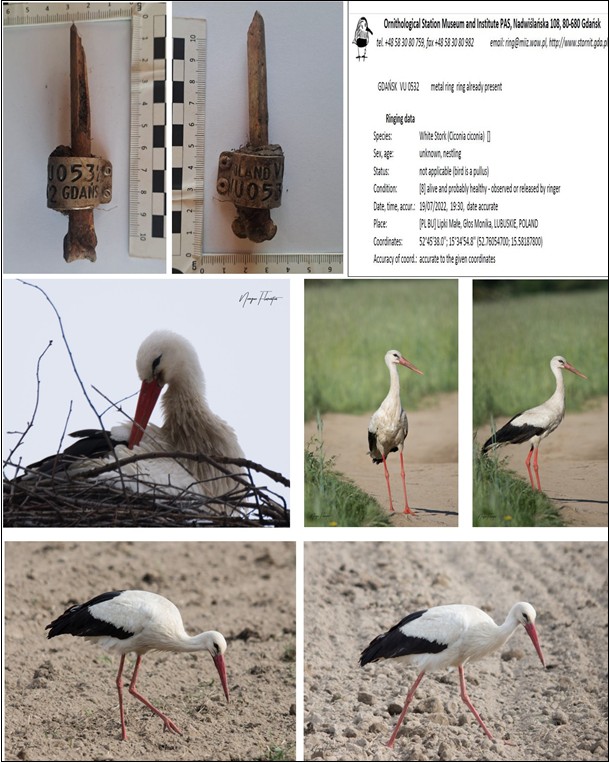
A telling example comes from near the city of Sfântu Gheorghe, in the village of Ilieni (Covasna County). During a routine detecting session, Mr. Isar Ștefănel discovered a fragment of a long bone from a bird’s leg, bearing a metal ring inscribed with a numerical code. The ring differed from those used for domestic pigeons, having a larger diameter and weight, and the inscription indicated it originated from Poland (Figs. 1–2).
This discovery brought together metal detecting and archaeology in a shared investigative effort. Archaeologists from Sfântu Gheorghe, from the National Museum of the Eastern Carpathians (through Dan Buzea), collaborated with specialists from Poland, including Dr. Maciej Dębiec of the University of Rzeszów, to decipher the inscription “GDAŃSK VU 0532.” It was determined that the ring belonged to a white stork.
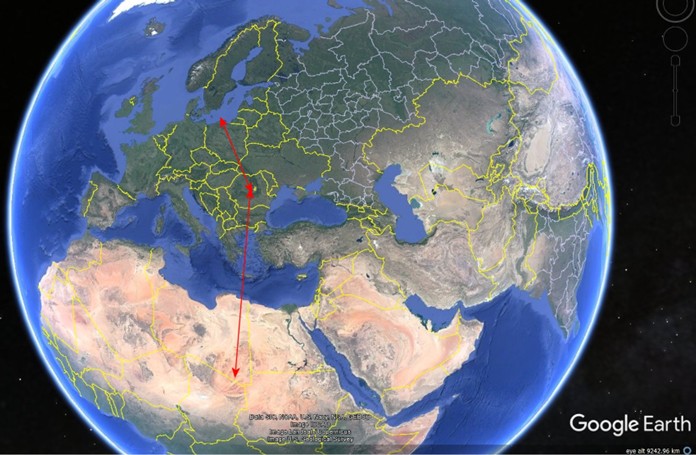
The precise identification was made possible through collaboration with the Ornithological Station Museum and Institute PAS in Gdańsk, an institution involved in monitoring migratory birds. According to their data, the stork had been recorded in Poland on July 19, 2022, in the locality of Lipki Małe (Lubusz Voivodeship). Over the course of 1,245 days, it traveled thousands of kilometers along migration routes between Europe and the warm regions of tropical Africa. Unfortunately, the exact moment of its death could not be established.
The white stork (Ciconia ciconia) is a species well adapted to agricultural environments, preferring areas with access to water—rivers, wetlands, or flooded fields. The largest populations are found in Eastern Europe, while those in northwestern regions are in decline, most likely due to drainage works and electrical infrastructure. It usually nests solitarily, often on electricity poles or rooftops, and is highly accustomed to human presence. In Romania, it is a summer visitor, typically returning in April, though sometimes as early as March. It migrates in August to tropical Africa, passing through key points such as the Bosphorus and Gibraltar, and feeds on frogs, insects, snakes, bird chicks, and small rodents (Figs. 4–8).
This discovery demonstrates how important an apparently insignificant metal object can be. Had the ring been ignored, valuable information about the route and fate of this stork would have been lost. Through collaboration between a detectorist, a museum, and research institutions, it was possible to reconstruct a migration story and contribute to the study of these birds.
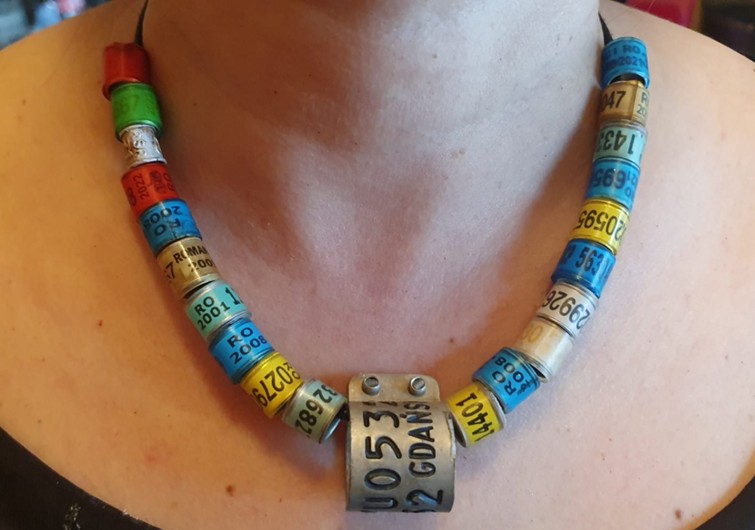
Similar situations occur with rings belonging to carrier pigeons, which bear inscriptions indicating origin, date, and location. When properly documented, these can provide valuable scientific data; otherwise, they remain simple collectible items or ornaments, albeit with the potential to become heritage objects over time.
Thus, metal detecting is not limited to archaeological discoveries—it can also lead to unexpected contributions in fields such as ornithology or migration studies. Sometimes, a simple search in the soil can reveal a story that connects continents, disciplines, and people.
Authors: Dan-Lucian Buzea, Cosmina Marcela Oltean, Isar Ștefănel
Photographs: Florentin Neagoe; MNCR